
 229 lượt xem


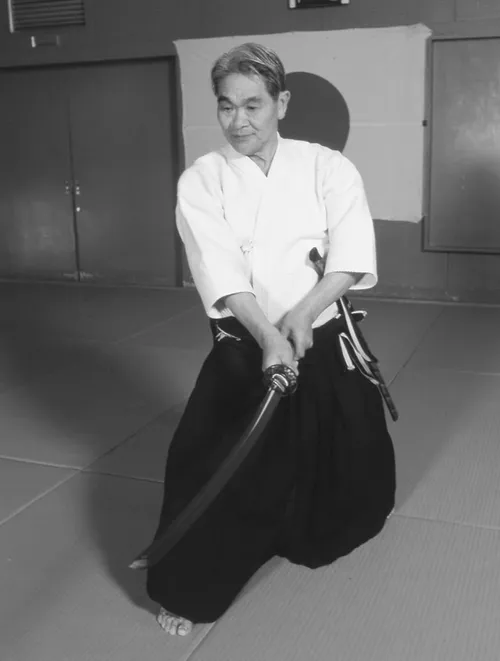
The following is an interview of Shoji Nishio Sensei, a well-known 8th dan instructor in the Tokyo area. The interview was held on May 22, 1983 in Tokyo.
From Judo and Karate to Aikido
Aiki News: We understand that you first practiced Judo and Karate. What made you begin to train in Aikido?
Nishio Sensei: When I first came to Tokyo, I was rather frail. I didn't do anything. In 1942, after the war broke out, I used to go to the city Judo dojo. I was working for a public office then. In 1944, after the air raids, I started working the night shift so I was unable to continue my training.
The war ended on August 15, 1945 and I went to the Kodokan on the 1st of September of the same year. There wasn't anybody. There wasn't even any glass in the windows. It must have been melted by the heat during the air raids. There was only half the number of tatami. The only person there was the old caretaker. There were no application forms. I just used plain paper and left it there. Then, I was contacted by the Kodokan and received a certificate of approval to begin training.
Aiki News: How old were you then?
Nishio Sensei: I was eighteen. I was the first person to enter the Kodokan after the war. (Laughter) Anyway, there wasn't anybody. There were no lights so it was not possible to train in the evening when it became dark. There was a time when I went there and practiced ukemi by myself and then went home. That's how it was.
About that time, the demobilization started. A lot of people appeared at the Kodokan. The following year it became very active. I was promoted to 3rd dan and 4th dan. I began to notice that there were restrictions in techniques because of competition. Because of that problem, I felt the limitations of Judo and started Karate. My teacher was Konishi Sensei of Jinen-ryu who had practiced Karate longer than anyone else at that time.
I was practicing Karate with Konishi Sensei but I also felt the limitation of Karate. I thought there must be something else.
The Encounter with O-Sensei
At that time, a former Karate sensei of the Butokukai named Toyosaku Sodeyama, who was running Konishi Sensei's dojo and also teaching there, came up to me and said: "I met someone who is like a 'phantom'. I couldn't strike him even once." I was amazed that there was someone that even Sodeyama Sensei couldn't strike. It was O-Sensei.
Sodeyama Sensei came back to Japan after the war. Since he did not have anywhere to go he came to Konishi Sensei. Then he was told to come to Hombu. Sodeyama Sensei laughed to himself thinking that this Aikido was being performed by such an old man. O-Sensei felt that the Karate sensei was making light of him and said: "You are thinking that you can strike me, aren't you?" Sodeyama answered: "Yes." O-Sensei then responded: "I see. I see. Strike me. I'll just walk around. If you can, strike me."
Then he started to walk around the dojo. Sodeyama Sensei felt vexed as though he was being made a fool of. If they were confronting each other face to face it would have been all right, but O-Sensei turned his back and started walking around inviting him to strike. (Laughter)
Sodeyama Sensei thought to himself: "What the hell kind of old man is this!", and suddenly got up and tried to strike O-Sensei. But O-Sensei turned around and said: "What's the matter?" Sodeyama Sensei froze in the act of striking with his hand poised in mid-air. In the twinkling of an eye, there was a distance between them. Saying, "Damn it!" to himself he tried to strike him again. Then O-Sensei repeated, "What's the matter?" (Laughter) He couldn't strike him at all.
Then Sodeyama Sensei realized he had encountered a great sensei. He had to give full credit to O-Sensei saying, "I give up!" It was Sodeyama Sensei who told Mr. Nakajima and me to go to see O-Sensei and so we went. It was around 1951. Anyway, I went to see Aikido and immediately joined the dojo. I was told to go and see but I never went back. (Laughter)
Mr. Nakajima didn't join up, however, saying he wanted to do a little more Karate. After one year, he came to practice Aikido. He practiced Karate and became a 6th dan. He continued Aikido until receiving his 2nd dan. He told me that his viewpoint on Karate as a budo had changed. I thought that if I used this kokyu I might be able to go back to Judo, however.
The Stolen Coat — A Lesson in Budo Spirit
Mr. Tohei went to Hawaii in 1953. On his return, he brought back a leather coat which was impossible to obtain at that time in Japan. It had fringes like the ones you see in western movies. He had a leather coat when it was impossible even to obtain leather shoes... I really thought it was amazing. Then, that coat was skillfully stolen.
That was what had happened when I turned up for training. I saw that all of the uchideshi had been made to sit in seiza and Mr. Tohei was shouting something. Then I heard that Tohei Sensei's coat had been stolen. At that time Mr. Noguchi, Mr. Genta Okumura and Mr. Sunadomari were some of the uchideshi.
Then O-Sensei appeared asking, "What's up?" When Mr. Sunadomari explained what had happened O-Sensei responded: "Oh, it was stolen, was it?" (Laughter) Then he came into the dojo. Tohei Sensei also sat in seiza because O-Sensei entered. O-Sensei started to walk around them. We were really wondering what he was going to say.
What he said was: "You're the one to blame, Tohei."
Then, he disappeared. Tohei sat silently for a while. Then he, too, disappeared. Everybody was relieved and started training. (Laughter)
After practice, I was leaving for home and ran into O-Sensei who was on his way to the bathroom. I went up to him and said, "O-Sensei!" He said, "Ooh!" I asked, "A few minutes ago when Tohei Sensei had his coat stolen, you said he was the one at fault. Why did you say that?"
He answered:
"Don't you understand why? Those who practice budo shouldn't have that kind of spirit. One shouldn't show off things which people desire to have. You can show off things you can give, but otherwise you shouldn't. Poor man, he took the coat because he wanted it. However, by taking it, he became a thief. It's all right to have the coat stolen, but he was made a thief. Stealing is a bad thing, but the man whose coat was stolen committed the original sin. He created the occasion for an opening (suki) in the man. As a budoka, that's bad."
I was really amazed and I learned the depth of Aikido. To tell the truth, when I was practicing Judo, Mifune Sensei's house was robbed twice in his absence. Those incidents were written up in a monthly magazine entitled "Judo" published by the Kodokan. Mifune Sensei was quoted as saying, "The next time he robs my house in my presence, I will catch him no matter what happens, even if I am killed!" An old man, nearly seventy was saying he would catch him even if he was killed...
I was really impressed by Mifune Sensei's reaction at that time. However, there was a big difference between O-Sensei's and Mifune Sensei's words. One was saying he would catch him even if he was killed and take him to the police. The other was saying that the thief took it because he wanted it and that he should be let to have it, that it was the person who was robbed that was at fault. There was a world of difference between the two spirits.
I thought that even though one practiced Judo all of his life, he could only reach this stage. On the other hand, I thought that the depth of Aikido as budo was great. It was that incident which caused me to stop my Judo training.
O-Sensei's Teaching and Legacy
O-Sensei's way of thinking appeared in practice itself. He said, "It's wrong to use the words 'winning and losing'. You shouldn't think in those terms." His words were great. As we continue to live I think it's important to digest all of his words.
They say that O-Sensei practiced the sword and staff, but he did so in the process of giving birth to modern Aikido. Even though we imitate him we will not be able to go beyond what he did. O-Sensei used to tell us:
"This old man reached this stage, you should surpass me building on what I have left."
However, we tend to imitate what he did and end up going backward. Ten years from now, we may be practicing the level of Aikido of O-Sensei as it was a number of years ago. After fifteen years, we may end up going back to the forms he practiced at an even earlier date. This is not right, he told us over and over again to go beyond what he did. People like us didn't understand what he meant. But after several years, when we ran into some obstacle, we would think to ourselves, "Oh, that's what he used to talk about." Our activities depend on O-Sensei's words.
Memories of O-Sensei
Aiki News: When you began practicing Aikido was O-Sensei living in Tokyo?
Nishio Sensei: No. He rarely came down from Iwama. It was half a year after I joined the dojo that I saw his face for the first time. Until then, I only knew about him by hearsay. There weren't any pictures of him like we have now.
You know Mr. Otake who lives in Iwate Prefecture now, he used to be the captain of the Kendo Club at Waseda University. He participated in the National Kendo Championship several times and became famous as a representative of Tohoku Prefecture. It was he who told me, "This is it! He looked exactly like this", while pointing at a drawing of a dragon with glaring eyes hanging in the tokonoma. I used to think "Gee, does he really look like this!" (Laughter)
When he smiled, his eyes disappeared. But when you just caught a glance of him, the impression was really strong. When he looked at something for a second, his face disappeared into his eyes. (Laughter)
O-Sensei used to tell us a story. We were really cheeky. For the most part, people did not approach O-Sensei... Whenever I had a question I went up to O-Sensei and asked, "O-Sensei, there was something I didn't understand of what you said a little while ago." Sensei would say, "Oh, good you noticed that." O-Sensei often had me draw a circle, triangle and a square and would say, "Keep it with you and bring it to me when I need it."
One day, when a guest came it happened that he explained the drawing and I was told to give it to him. But when I looked at the present Doshu he made a negative gesture. I think it was because once O-Sensei began talking about the drawing the conversation would be long and would be an imposition on the guest since he wouldn't understand it. I was in hot water. One of them told me to bring it and the other, the opposite... Also, I myself had drawn it. O-Sensei asked, "What's the matter?" So, there was nothing for me to do but give it to him. If that drawing was put somewhere, it would always disappear! (Laughter) Then, he would say, "Oh! It's gone!" and have someone redraw it.
The Last Photograph
One week before O-Sensei entered the hospital, we posed for pictures with him. I said to him, "Sensei, let's take a picture." He told me to bring him his montsuki (kimono bearing family crest). He said, "My photo will remain. What I'm wearing is not appropriate."
I went to the present Doshu's wife and asked for the montsuki explaining that we were going to take a picture of O-Sensei. Well, she sure complained a lot. (Laughter) It was very troublesome to have to dress him up in his montsuki. Anyway, we finally got him dressed. There was a sign which read "Aikido School" and I think he wanted a picture to be taken in front of the sign. He stroked the sign affectionately. We took the pictures there. That was in February 1969. One week after that he entered the hospital. That was the last picture.
O-Sensei passed away on the 26th of April. I had a call in the morning and I drove fast to his bedside. I was the first one to arrive. Then Mr. Okumura, Mr. Yamaguchi and Mr. Tada came. His face was really beautiful like a Noh mask of an old man. If one dies of cancer, there is usually a lot of suffering and the pain remains on the face. But, that wasn't the case with O-Sensei. He had a divinely beautiful face.
The Role of Hombu Dojo
Aiki News: What is the role of the present Hombu Dojo?
Mr. Ito: Their duty is to re-evaluate and run the organization properly.
Nishio Sensei: I think so, too. Nowadays, there are many branches all over Japan. But these are not at all functioning as branches, they are branches in name only but not in fact. This is because there aren't talented people who can make them function or there may be some people preventing the branches from functioning.
For the future development of Aikido, we need the strength to remove the grumblers. We shouldn't indulge ourselves. Some people might say that a forgiving mind is the expression of Aikido, but I don't think we can run the organization with that feeling. If you think of the future, we should band together. But if someone changes his mind, we should forgive him. That's the Aikido way of thinking. It shouldn't be a permanent exile. If the person himself changes his mind, we should forgive him. The central point of Aikido is forgiving.
During daily practice, people who don't know how and when to draw a sword or how to sheathe the sword shouldn't swing the sword. As a result, they will cause damage everywhere. Sheathing the sword without hurting anyone is the future Aikido. We should learn the proper way of wielding the sword. You have to be able to express humanity through individual techniques. Those who only can execute ikkyo, nikyo and sankyo are not professionals. We should be able to express humanity with our bodies.
The Importance of Fundamentals
For example, the rank of gokyu involves knowing how to move about properly. We should start learning how to sit, stand up and walk properly. Proper behavior is really difficult. The budo world is completely at fault with regard to this point. Whatever is done is ineffective. They merely assume a stance. We have to begin correcting this. We teach this through the ken.
The way of walking of many people is wasteful. If there is approximately five centimeters difference in each step you take, there would be a great difference of distance after taking a hundred or thousand steps. Another thing is that unneeded power is used. To make them understand this idea, I have students use the ken.
On Attacking in Aikido
Aiki News: In what way should Aikido beginners practice attacking?
Nishio Sensei: In Aikido there is no preemptive strike. But in budo training, a proper shomenuchi and proper tsuki are basic. In my dojo I teach how to grab, how to stand up, how to swing the sword and the tsuki and oblique stance and yokomen. Proper grabbing, proper swinging and proper striking are transformed into atemi instantly. The reason I have students use the ken is to have them recognize these movements. In budo, you are inferior and the opponent is superior to you. Your opponent has more power than you. That's very important. Techniques are for freely handling stronger people. Your power shouldn't lessen even a little. You have to display 100% power through your body.
Aiki News: What is the importance of warming up before practice?
Nishio Sensei: Even though you are warming up, you should always display your power. When we warm up we move our hands around, but in budo there is a possibility of victory or defeat in these movements. You must pay great attention to these movements.
The way of warming up is different depending on the dojo. In my dojo I explain the meaning of every single movement in the budo sense and have students practice. We can re-apply any form, like tsuki, kicks and ken and jo. By doing this we explain the rules of ken, the rules of jo and how to grab the ken and jo with the students actually holding these weapons.
Aikido's Duty to Other Martial Arts
I usually say that students should improve themselves by acquiring familiarity with the characteristics of Judo, Karate and Kendo. You won't get anywhere by criticizing these arts. Those who say they are worthless are themselves worthless. You can further improve yourself by keeping in mind that they are wonderful arts.
Without restricting ourselves to Aikido only, we should teach Judo, Kendo and Karate people the true content of Japanese budo. "You have these positive aspects which we are learning from your arts." Conversely, we should teach them the wonderful aspects of Judo, Kendo and Karate. I think this is the duty of people who practice Aikido.
There are various kinds of people who come to my dojo. When I go to a regional area, Kendo and Karate people come. For example, atemi is for stopping the opponent's initiative in an instant and for controlling him without endangering him. This is what atemi should be. I think that this is a new way of doing Karate. Karate where you hit your opponent with full power isn't good. I think our duty as Aikidoists is to teach Karate people the true budo life.
I never limit myself to only a few opponents but always pay attention to Judo, Kendo and Karate. We should teach them a deeper Judo, Karate and Kendo. This is one of our tasks. We are finished if we only do "Aiki Dance".
The Meaning of "One Step" — Irimi
In Aikido, one step means to accept the attack of the opponent. It shouldn't be one step which ignores people. I wish people would recognize and help each other and complement each other. Our "one step" means "irimi" which has great content. It is to lead the partner. We should face the partner. If you turn away, he will turn away too.
We can express humanistic traits through striking, kicking and use of the ken and jo in Aikido as budo. In my case, I have my own opinion and I express it. I can reapply it in an easily understandable form. Until now, people have only imitated. If they adopt old ways, they will not improve. Being old means being noneffective. If you practice in that way it doesn't work now.
On Miyamoto Musashi
In the Aikido sense, Miyamoto Musashi is the biggest coward. There is no one more cowardly than him. He was a pitiable man. In the Japanese budo world, they say that there is no one greater than Musashi. But I tell Iai and Kendo people without apology that Musashi was a cowardly person all of his life.
He was a wild animal afraid of the rustle of trees and plants and the sound of the wind. He never had a wife, never took a bath and died in a cave. Even when I read The Book of Five Rings, I wasn't at all impressed. It doesn't include human emotion. He lived all of his life in fear and trembling.
It doesn't matter if you bump into a person. If you are a person who can say, "Hi! How are you?", it's wonderful, isn't it? Instead, if you become angry and say, "You bastard!", you're not a human being but a wild animal. That's what I say. Musashi was the lowest form of human being. I say without apology you should never become like him. I think much of humanity.
On Publishing and Constant Improvement
Aiki News: Are you thinking of publishing a book?
Nishio Sensei: I'm always practicing and questioning. So I can't arrive at an absolute opinion. If you write a book and then die dissatisfied with it, who is going to rewrite it for you? Take the example of Saito Sensei's books. At that time his techniques were the best, but now there are some aspects which are unsuitable. Especially, in the technical sense. You have to constantly keep rewriting. That is the case even for a person of such a high level.
Aikido is to fell your opponent before touching him. You shouldn't fell him by clashing against him. You should never hit him. You should lead him without hitting him. This is our way. Most people don't understand this.
O-Sensei's Principle of the "Half-Step"
Aiki is wonderful. We practice it because we have fallen in love with something none of the other martial arts offer. O-Sensei told me this:
"One step means discontinuity. Aikido involves a 'half-step'. The 'half-step' is contact."
This is a guiding principle. If you take one step, it implies discontinuity. O-Sensei's way of expressing this idea is a little strange. I had a hard time understanding what he meant. He would say, "'One step' implies 'discontinuity'. You should take a 'half-step.' There should be 'contact'. Sanai Hashimoto and Choei Takano had a good idea in the late Edo Period but both were killed. That was because they took 'one step'. If they had taken a 'half-step,' they wouldn't have been killed."
If you go to extremes, you'll be done in. O-Sensei always said that leaders should act while maintaining contact.
Teaching and Leadership
When people of the 5th or 6th dan levels teach beginners they should not be condescending to them. Instead they should come down to their level and help them. It's difficult to go from a lower level to a higher level, but easy to go from a higher level to a lower level. That kind of thinking is needed in present-day society.
No one follows you if you use the form of "discontinuity." If you only complain and give orders from a higher position no one moves for you. However, if you come down and say, "Let's do it!", people will move for you. The Aikido way of leading is alive in the real society.
When you say something to someone, what is important is not to talk a lot. What is important about saying something is to be understood. If you can't be understood, it's better not to say anything. Much less, if your partner feels a strong negative reaction towards you, it's better not to say anything.
The True Purpose of the Ken
In this bureaucratic world, if you can say, "I already said that," then you have an excuse. This is counterproductive. What government officials or people in an administrative position have is authority — and "ken" (fist) is "kenryoku" and the "ken" (sword) we swing is also "kenryoku." However, our "ken" is not for cutting people. It's for allowing people to live. It's a wish for happiness, it creates happiness.
The purpose of the ken is to cut a way through brambles. The ken of old Japan was always like that. Aikido's duty is to re-transform the ken to its former correct form. The purpose of the ken in Aikido is to cut a way for people, not to cut people.
That's why it's wonderful. O-Sensei said so too.
Natural Stance — Already Winning
We don't assume a stance in Aikido. O-Sensei said:
"It's wrong to take a stance. Taking a stance causes fights. If you don't take a stance there's no victory or defeat. You will always win. In Aikido, you win from the beginning."
Usually when your opponent assumes a stance and you do nothing, you feel uneasy. However, if you stand naturally you can enter immediately when it appears that your opponent is about to move. When your opponent moves you have already won.
When you stand naturally, the form of the ken is already inside you. In other words, you yourself are inside the ken and you don't have a body of your own. This is natural. Because you are within the ken there is no way the opponent can strike you. When he moves, you move, so you have already won. If you take a stance, you lose. If you take a stance wondering how to move, it becomes a cause of conflict.
The Spirit of Aikido
O-Sensei's Aikido is a wonderful way of living and form of expression. I apply these ideas in my training. They are wonderful and can be applied to any opponent. Human beings should not fight. They should instead love each other, help each other, and complement each other. By doing so, they create a humane world. I accept anyone who understands this spirit.
What is Aikido seeking? It's not at all superficial. We have not yet reached this ideal. We advance slowly without impatience. I think practice means communication.
The way of living I learned from O-Sensei is not a matter of strength and weakness. As I told you before, I felt a great difference between the attitude of the two senseis with regard to the theft incidents.
Japanese Budo Spirit vs. Western Knight Spirit
The fundamental principles of the Japanese martial spirit are different from the spirit of present sports or the spirit of the western knight. The spirit of the western knight gave rise to present sports. They fight for themselves or their own honor sacrificing everything. But this is not the Japanese budo spirit. They fought for the country, for their people, not for themselves or their honor.
In the spirit of Japanese budo one fights together with one's family for society and the people. With that spirit in mind we eliminate conflict. If you fight by yourself fighting will be endless. If people who say, "I can die to prevent others from being killed" get together, conflict will be eliminated. This is the spirit Aikido seeks.
There is a big difference between the Japanese bushido spirit and the budo spirit. We shouldn't make winners and losers. If we have winners and losers we have conflict. If that disappears, we will have a peaceful world.
True Aikido doesn't need the word "lose."
That's what I think. When O-Sensei first said, "It is not Aikido if there is winning and losing...", I thought that he was saying something strange. I thought that without winning and losing in the budo world, victory and defeat couldn't exist. But it's easy to understand if I think of it now. Winning and losing means conflict. That's what he meant. His way of thinking was ahead of the times. He had already said such a thing in that period.
Closing Words
I would like to express O-Sensei's way in a new manner. O-Sensei said that it is a crime to fell opponents or hurt them even a bit. I tell students if they have to hit the opponent to execute a technique when their hands are held, they shouldn't do that technique. If you have to use atemi, entering with a strike, then you shouldn't do that particular technique. Aikido doesn't need that. We never hit the opponent when we do kaitennage, for example, at the beginning of training.
Thank you for taking time out of your busy schedule to grant us this most interesting interview.
Translated by Stanley Pranin and Ikuko Kimura
Dưới đây là phần đầu của cuộc phỏng vấn hai phần với Nishio Shoji Sensei, một giảng sư nổi tiếng 8 đẳng hoạt động tại khu vực Tokyo. Cuộc phỏng vấn được thực hiện ngày 22 tháng 5 năm 1983 tại Tokyo.
(Bản dịch tiếng Việt sẽ được cập nhật)
Bình luận
Các bình luận được kiểm duyệt. Hãy lưu ý điều tiết ngôn ngữ và thể hiện tôn trọng.